The Present & Future of Performance Marketing: Human Strategy vs AI Execution
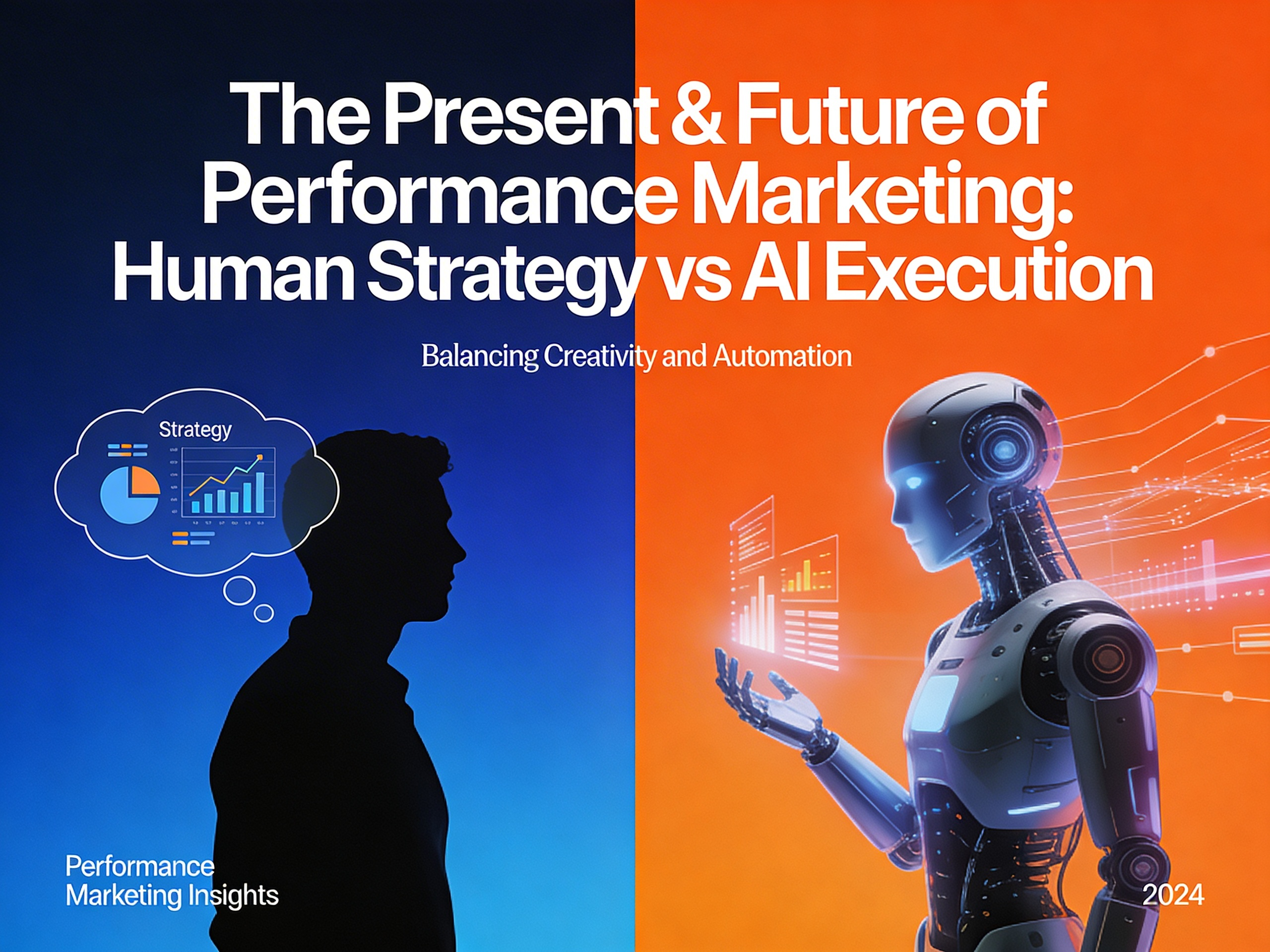
There’s a running joke among performance marketers that didn’t exist five years ago. It goes something like this: “I used to optimize campaigns. Now I optimize the AI that optimizes campaigns.” It gets a tired laugh in Slack channels and conference hallways because it’s painfully accurate. The job hasn’t disappeared—far from it—but it’s shapeshifted into something most of us didn’t see coming when we first learned to split-test a landing page headline.
Let me be honest with you. If you’re reading this expecting a neat, balanced take that says “AI is a tool, humans are still in charge, everything’s fine,” I’m going to disappoint you a little. The reality is messier. More interesting, too. The relationship between human strategy and AI execution in performance marketing isn’t a clean handshake. It’s more like two people trying to drive the same car, and we’re still figuring out who holds the wheel and who reads the map.
Where We Actually Are Right Now
Let’s ground this before we start projecting into the future.
Right now, in early 2026, most mid-to-large performance marketing operations run on a stack that would’ve felt like science fiction a decade ago. Google’s Performance Max campaigns have essentially taken the concept of manual channel selection and set it on fire. Meta’s Advantage+ shopping campaigns decide creative combinations, audience segments, and placements with minimal human input. Programmatic platforms like The Trade Desk and DV360 use machine learning models that process thousands of signals per impression—device type, weather, time of day, browsing history, purchase intent—before deciding whether to bid and how much, all within the time it takes a webpage to load.
And that’s just the buying side. On the creative end, generative AI tools can produce dozens of ad variations in minutes. Copy, images, even short-form video. You feed them a brief, maybe some brand guidelines, and out comes a buffet of assets that would’ve taken a creative team two weeks and a handful of tense review meetings to produce.
So here’s the question that keeps coming up in strategy meetings and LinkedIn debates and late-night conversations between marketers who’ve been in this game long enough to feel the ground shifting: if the machines handle targeting, bidding, placement, and increasingly the creative itself, what exactly is the human being paid to do?
That question isn’t theoretical anymore. It’s operational.
The Stuff AI Does Better (And We Need to Admit It)
Pride is expensive in this industry. I’ve watched performance marketers cling to manual bidding strategies like a security blanket, convinced their gut instinct about a CPC cap was sharper than an algorithm trained on billions of auction outcomes. Sometimes they were right. Most of the time, they weren’t.
AI is flatly, demonstrably better at certain aspects of performance marketing. Speed of data processing is the obvious one, but it goes deeper than that. Pattern recognition across massive datasets, real-time budget reallocation, multivariate testing at a scale no human team could manage, fatigue detection in creative assets before performance metrics visibly decline—these aren’t marginal improvements. They’re category shifts.
Take audience segmentation as a specific example. A skilled media buyer might identify four or five meaningful audience clusters based on demographics, interests, and behavioral signals. A well-trained machine learning model, working with the same data, might surface forty-seven micro-segments, some of which no human would’ve thought to test. A segment of users who browse outdoor gear between 10 PM and midnight on weekdays and respond disproportionately to earth-toned static images over video? No human strategist is finding that. The machine did, and ROAS went up fourteen percent.
Pretending this isn’t happening doesn’t help anyone. The faster we acknowledge what AI genuinely does better, the faster we can focus on what it genuinely doesn’t.
The Stuff AI Gets Wrong (And Why It Matters More Than You Think)
Here’s where it gets interesting, and where the “human strategy” half of this conversation earns its paycheck.
AI in performance marketing operates on optimization toward defined metrics. That sounds clean until you realize that the metric itself is a human decision—and a frequently flawed one. I’ve seen AI systems ruthlessly optimize toward a cost-per-lead target, flooding a sales pipeline with low-intent leads that convert on paper but churn within thirty days. The algorithm did its job perfectly. The business outcome was terrible. The disconnect wasn’t a technical failure. It was a strategic one. A human chose the wrong north star, and the machine sprinted toward it with impressive efficiency.
This happens constantly, and it reveals a fundamental limitation that no amount of compute power fixes: AI doesn’t understand context the way humans do. It doesn’t know that your brand just went through a PR crisis and the aggressive retargeting campaign suddenly reads as tone-deaf. It doesn’t grasp that the market you’re expanding into has cultural sensitivities around certain imagery. It can’t feel the subtle shift in consumer sentiment after a competitor’s product launch tanks and suddenly there’s an opening nobody’s advertising toward yet.
Machines optimize within the frame. Humans build the frame.
That distinction sounds abstract until it costs you six figures on a campaign that technically hit every KPI but moved the brand backward. Then it feels very concrete.
The Strategy Layer AI Can’t Replicate (Yet)
Let me break down what I mean by “human strategy” because the phrase gets thrown around loosely enough to lose meaning.
Positioning decisions. Where does this brand sit in the market, and why should anyone care? This requires understanding competitive dynamics, cultural currents, and the almost irrational emotional reasons people choose one product over another. AI can analyze sentiment data and competitor ad spend. It cannot decide that your brand should lean into vulnerability instead of aspiration because the market is fatigued with polished perfection. That’s a human read on human psychology, informed by lived experience and instinct sharpened over years.
Narrative architecture. Performance marketing isn’t just about getting clicks. At its best, it builds a story across touchpoints—awareness, consideration, conversion, retention—where each interaction feels like a coherent chapter rather than a random interruption. AI can sequence ads based on funnel position and engagement signals, but the underlying narrative? The reason the story resonates? That’s still crafted by people who understand that buying is emotional first and rational second.
Ethical judgment. This one’s uncomfortable but unavoidable. AI will target vulnerable populations if the data says they convert. It will serve alcohol ads to users exhibiting addictive browsing patterns if nobody tells it not to. It will push aggressive urgency tactics on audiences showing financial stress signals because those tactics technically improve conversion rates. The guardrails are human decisions. The AI doesn’t have an opinion about whether a tactic is exploitative. It has a performance score.
Cross-channel orchestration with business context. How does paid search interact with the organic content strategy, the email nurture sequence, the retail partner’s promotional calendar, and the product team’s upcoming feature launch? These interdependencies require judgment, communication across teams, and an understanding of business priorities that shift week to week. No AI system currently handles this well because it requires organizational knowledge that lives in people’s heads and Slack threads, not in structured data feeds.
What the Future Probably Looks Like
I say “probably” because anyone who speaks about the future of marketing with certainty is selling you something.
That said, the trajectory is visible enough to make reasonable projections.
The strategist role becomes more important, not less. As execution gets automated, the quality of the strategic input becomes the primary variable. Two companies using the same AI tools with different strategic frameworks will see wildly different outcomes. The human who can define the right objectives, build the right measurement framework, and make the right creative and positioning calls becomes the highest-leverage person in the operation. Not the one pulling levers in the ad platform.
Creative becomes the last frontier. AI-generated creative is getting better fast, but “better” in this context means “more competent.” Competent creative doesn’t break through. Distinctive creative does—the kind rooted in a specific cultural insight, an unexpected visual language, a tone of voice that feels like it was written by someone who’s actually experienced the problem being solved. Performance marketers who develop sharp creative instincts alongside their analytical skills will be extremely difficult to replace.
The feedback loop gets tighter. Right now, there’s often a lag between strategy and execution—a human sets the plan, the AI runs it, then the human reviews results and adjusts. That cycle is compressing. We’re moving toward environments where AI surfaces real-time strategic recommendations alongside execution data, and the human’s role shifts toward rapid evaluation and approval rather than manual campaign building. Think of it less like driving a car and more like supervising an autonomous vehicle—most of the time it handles things fine, but you need to be ready to grab the wheel when it encounters a situation it wasn’t trained for.
New skills become non-negotiable. Prompt engineering for creative AI tools. Understanding of machine learning fundamentals—not to build models, but to know when one is misbehaving and why. Data storytelling for stakeholders who don’t speak marketing but control budgets. Ethical frameworks for targeting and personalization decisions. These aren’t “nice to have” skills on a resume anymore. They’re the job.
The Part Nobody Wants to Say Out Loud
Some performance marketing roles are going to disappear. Not eventually. Soon. The junior media buyer who manually adjusts bids and moves budget between ad sets—that role is already hollowing out. The reporting analyst who pulls data from five platforms into a spreadsheet every Monday—automation handles that now. Entry-level execution work is shrinking, and the industry hasn’t fully reckoned with what that means for the talent pipeline.
If junior roles disappear, where do senior strategists come from? You can’t develop marketing intuition without years of hands-on experience, and if the hands-on work gets automated, we have a gap forming. The companies that figure this out—building new training pathways, apprenticeship models, hybrid roles where junior marketers learn strategy alongside AI supervision—will have a significant advantage in five years. The ones that just cut headcount and lean on automation will find themselves with powerful tools and nobody skilled enough to point them in the right direction.
So Where Does That Leave Us
Sitting with the tension, honestly. The present state of performance marketing is a partnership between human strategy and AI execution, but it’s an unequal and evolving one. The balance shifts a little more toward machines every quarter. The humans who thrive in this environment won’t be the ones who compete with AI on speed or data processing. They’ll be the ones who do what the machines can’t—think in narratives, read cultural undercurrents, make judgment calls in ambiguous situations, and take accountability for outcomes that an algorithm will never lose sleep over.
The future belongs to performance marketers who treat AI as infrastructure and strategy as the product. Build the frame well, and the machines will fill it brilliantly. Build it poorly, and all that computational power just gets you to the wrong destination faster than ever before.
That’s the job now. It’s harder than pulling levers in an ad platform. It’s also far more valuable, and frankly, a lot more interesting.