The Core of Performance Marketing: Tools, Tracking & Smart Optimization

Let me be honest with you for a second. Most blog posts about performance marketing read like they were written by someone who memorized a textbook but never actually ran a campaign at 2 AM, refreshing a dashboard, watching a CPA spike and trying to figure out what went wrong before the client wakes up.
This isn’t that kind of post.
I’ve spent enough time in ad platforms, analytics dashboards, and spreadsheet rabbit holes to know that performance marketing isn’t some neat, linear process. It’s messy. It’s iterative. And the people who are genuinely good at it aren’t the ones who know the most acronyms — they’re the ones who’ve burned enough budget to develop real instincts about what works and why.
So let’s get into it. The actual core of performance marketing. Not the buzzword version. The version that matters when money is on the line.
What Performance Marketing Actually Means (When You Strip Away the Jargon)
Performance marketing is paying for outcomes. That’s it. You’re not paying for eyeballs or impressions in some vague brand-awareness play. You’re paying when someone clicks, signs up, purchases, downloads, books a call — whatever action you’ve defined as valuable.
The beauty of it is accountability. Every dollar has a job. Every campaign has a measurable result. And if something isn’t working, you don’t need to guess. The data tells you. Sometimes it whispers. Sometimes it screams. Either way, it’s there.
But here’s what a lot of marketers get wrong early on: they treat performance marketing like it’s purely mechanical. Plug in the right keywords, set the right bid, launch the right creative, and money comes out the other end. That works for about five minutes. Then the algorithm shifts, a competitor outbids you, your audience gets fatigued, or the platform changes its attribution model overnight. Suddenly your “proven system” is bleeding cash.
The marketers who survive that moment — and thrive past it — are the ones who understand the three pillars holding everything up: the tools they use, the tracking they trust, and the optimization habits they build.
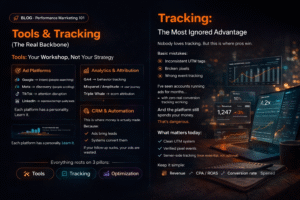 The Tools: Your Workshop,
Not Your Strategy
Walk into any marketing forum and you’ll find someone arguing that Tool X is better than Tool Y. Google Ads versus Meta Ads. SEMrush versus Ahrefs. Triple Whale versus Northbeam. These debates are endless and mostly pointless because the tool is never the strategy. A $200 chef’s knife doesn’t make you a chef. Your understanding of heat, timing, and flavor does that. The knife just makes the cuts cleaner.
That said, your toolkit matters. Here’s how I think about it.
Ad Platforms are where the money moves. Google Ads for intent-based capture — someone searches “best running shoes for flat feet” and you show up with exactly that. Meta Ads for demand generation — someone’s scrolling through vacation photos and your creative stops them mid-thumb. TikTok Ads for pattern interruption at scale. LinkedIn for B2B where the CPMs are brutal but the lead quality can justify every penny. Each platform has a personality. Google rewards relevance and structure. Meta rewards creative volume and testing velocity. TikTok rewards authenticity that doesn’t look like advertising. Learning those personalities takes time, and honestly, a fair amount of wasted spend. That’s tuition. Everyone pays it.
Analytics and Attribution platforms are where the truth lives (or at least the closest approximation of truth you’re going to get). Google Analytics 4, despite its clunky interface and the learning curve that made half the marketing world groan, remains foundational. It’s free, it integrates with nearly everything, and once you understand its event-based model, it gives you a surprisingly granular picture of user behavior. Beyond GA4, tools like Mixpanel or Amplitude let you dig into product-level analytics — how users actually move through your funnel, where they hesitate, where they drop. For e-commerce specifically, platforms like Triple Whale or Hyros attempt to stitch together attribution across channels, which becomes critical once you’re spending across Google, Meta, email, and organic simultaneously.
CRM and Automation tools tie everything together downstream. HubSpot, Klaviyo, ActiveCampaign — these aren’t just email senders. They’re where you build the post-click experience that determines whether your ad spend actually converts into revenue or just generates a list of names that go nowhere. A lead that hits your CRM and receives a generic “thanks for signing up” email is a lead you’ve already started losing. The automation layer is where you personalize, nurture, and guide that person toward the moment they’re ready to buy.
Creative and Landing Page tools round out the stack. Figma or Canva for ad creative. Unbounce or Webflow for landing pages you can iterate on without waiting three weeks for a developer. Speed matters here more than perfection. A “good enough” landing page live today outperforms a pixel-perfect page that launches next month.
The real skill isn’t mastering any single tool. It’s knowing which tool answers which question — and when to stop tweaking settings and start making decisions.
Tracking: The Unglamorous Foundation of Everything
Nobody gets into marketing because they love UTM parameters. But tracking is the difference between marketers who make confident decisions and marketers who make expensive guesses.
Let’s start with the basics that a surprising number of teams still get wrong. UTM tagging needs to be consistent, documented, and non-negotiable. Every campaign, every ad, every link that gets shared externally should carry UTM parameters that follow a naming convention your entire team understands. The moment someone tags a campaign “spring_sale_2026” and someone else tags the same campaign “SpringSale26,” your reporting fractures. You end up with fragmented data that takes hours to clean and still might not tell the full story.
Pixel and conversion tracking setup is the next layer. Meta’s pixel, Google’s global site tag, TikTok’s pixel — these need to be installed correctly, firing on the right events, and verified regularly. I’ve audited accounts where a pixel was “installed” but hadn’t actually fired a purchase event in three months because a site update broke the trigger. The ads kept running. The platform kept optimizing. But it was optimizing toward a phantom goal, burning budget against a signal that didn’t exist.
Server-side tracking has become increasingly important as browser privacy updates, iOS restrictions, and cookie deprecation chip away at client-side tracking accuracy. Running a server-side setup through Google Tag Manager’s server container or a tool like Stape gives you a more resilient data pipeline. It’s more technical to implement, and it’s not optional anymore for anyone spending serious money on paid media.
Then there’s the attribution question, which is less a question and more an ongoing philosophical debate dressed up in spreadsheet formulas. Last-click attribution is simple but misleading — it gives all the credit to the final touchpoint and ignores everything that came before. First-click attribution has the opposite problem. Linear, time-decay, and position-based models try to split the difference. Google’s data-driven attribution uses machine learning to weight touchpoints based on actual conversion patterns, which is genuinely useful but still imperfect.
My honest take: no attribution model is correct. They’re all approximations. The goal isn’t to find the “right” model. The goal is to pick one that aligns with your business model, understand its blind spots, and use it consistently so you can identify trends over time. Switching attribution models every quarter because the numbers don’t look flattering is a recipe for confusion, not clarity.
Dashboarding deserves a mention here too. Looker Studio, Tableau, or even a well-built Google Sheet — the format matters less than the discipline. A dashboard that nobody checks is decoration. A dashboard that surfaces the five or six metrics your team actually makes decisions from, updated reliably, reviewed weekly — that’s infrastructure. Keep it lean. Revenue, ROAS or CPA by channel, conversion rate by funnel stage, creative performance by variant, and spend pacing. Everything else is available if you need to drill down, but the surface-level view should tell you within thirty seconds whether things are healthy or on fire.
Smart Optimization: Where Instinct Meets Data
Optimization is where performance marketing becomes genuinely interesting — and where good marketers separate from great ones.
The temptation, especially early on, is to optimize constantly. Change the bid. Swap the headline. Adjust the audience. Kill the ad set. Launch a new one. There’s an addictive quality to it. Every change feels productive. But most of the time, over-optimization is just noise dressed up as strategy. Algorithms need time to learn. Campaigns need data volume before you can draw meaningful conclusions. Pulling the plug on an ad after 200 impressions and twelve hours isn’t optimization — it’s impatience.
Creative testing is the single highest-leverage optimization activity for most paid social campaigns. On Meta especially, creative is the targeting. The algorithm is sophisticated enough that broad audiences often outperform hyper-segmented ones, but only when the creative itself does the work of attracting the right person. Testing frameworks vary, but the principle stays the same: isolate one variable, give it enough budget and time to reach statistical significance, record the result, and build on what you learn. Hook variations tend to produce the largest swings. A different opening frame in a video ad or a different headline in a static image can double or halve your click-through rate. Body copy and CTA differences matter too, but the hook is where attention is won or lost.
Bid and budget optimization is more nuanced than “raise the budget on what’s working.” Scaling too aggressively too fast resets the learning phase and can tank performance. A general rule I follow: increase budget by no more than 20-30% every 48-72 hours on campaigns that are performing well. For bid strategies, letting the platform’s automated bidding run with a clear conversion goal and sufficient historical data usually outperforms manual CPC bidding — but only after you’ve accumulated enough conversion volume for the algorithm to have real signal to work with. Below thirty or fifty conversions per month, automated bidding can behave erratically.
Audience refinement still matters, especially on Google where keyword intent is the backbone. Negative keyword lists are criminally underused. Reviewing search term reports weekly and adding negatives is one of those boring, repetitive tasks that quietly saves thousands of dollars over time. On Meta, lookalike audiences built from high-value customer segments remain powerful, though the percentage range matters — a 1% lookalike is tighter and usually more qualified than a 5%, but the 5% gives you scale when you need it.
Landing page optimization is the other half of the equation that too many media buyers ignore because it’s “not their job.” A campaign with a 3% click-through rate and a 1% landing page conversion rate will always lose to a campaign with a 2% CTR and a 4% conversion rate. The math is simple. The execution requires testing headlines, social proof placement, form length, page speed, and mobile experience — relentlessly, over months, not once during launch week.
Funnel analysis ties it all together. Where are people entering? Where are they dropping? Is the drop-off happening at the landing page, at the pricing page, at the checkout, during onboarding? Each drop-off point has different implications and different solutions. A landing page drop-off might mean message mismatch between ad and page. A checkout drop-off might mean friction in the payment flow or unexpected shipping costs. A post-signup drop-off might mean your onboarding sequence is confusing or your product doesn’t deliver on the promise your ad made. Performance marketing doesn’t end at the click or even at the conversion. It ends at revenue retained.
Bringing It All Together
The marketers I admire most aren’t the ones with the flashiest case studies or the most complex tech stacks. They’re the ones who maintain a tight feedback loop between what the data says, what the creative communicates, and what the customer actually experiences. They treat every campaign as a hypothesis, not a guarantee. They document what they learn. They resist the urge to chase trends without understanding fundamentals first.
Performance marketing rewards patience disguised as speed. You move fast in execution — launching tests, building pages, iterating creative — but you move slowly in judgment. You let the data accumulate. You look for patterns, not anomalies. You make the unsexy changes that compound over weeks and months into results that actually hold up.
The tools will keep evolving. Tracking will keep getting more complex. New platforms will emerge and old ones will shift their algorithms without warning. None of that changes the core of what makes this work: clarity about what you’re measuring, honesty about what’s actually performing, and the discipline to optimize toward outcomes that matter rather than metrics that just feel good on a slide deck.
That’s the version of performance marketing I practice. Not the textbook version. The one that survives contact with real budgets, real clients, and real pressure to deliver.
As a performance marketer, my focus is always on driving measurable results — whether that’s optimizing cost-per-acquisition, scaling paid media campaigns across Google and Meta, or running A/B tests to squeeze every drop of ROI from a landing page. Unlike brand-focused roles, performance marketing lives and dies by the data, demanding a sharp analytical mind, a deep understanding of conversion funnels, and the agility to pivot strategies in real time based on what the numbers are telling you.